Common Time Signatures
Understand simple, compound and uneven time signatures, compare common groupings, and hear each pattern with an online metronome.
A time signature shows how written note values fill a measure. The grouping tells you where the larger pulses and accents fall.
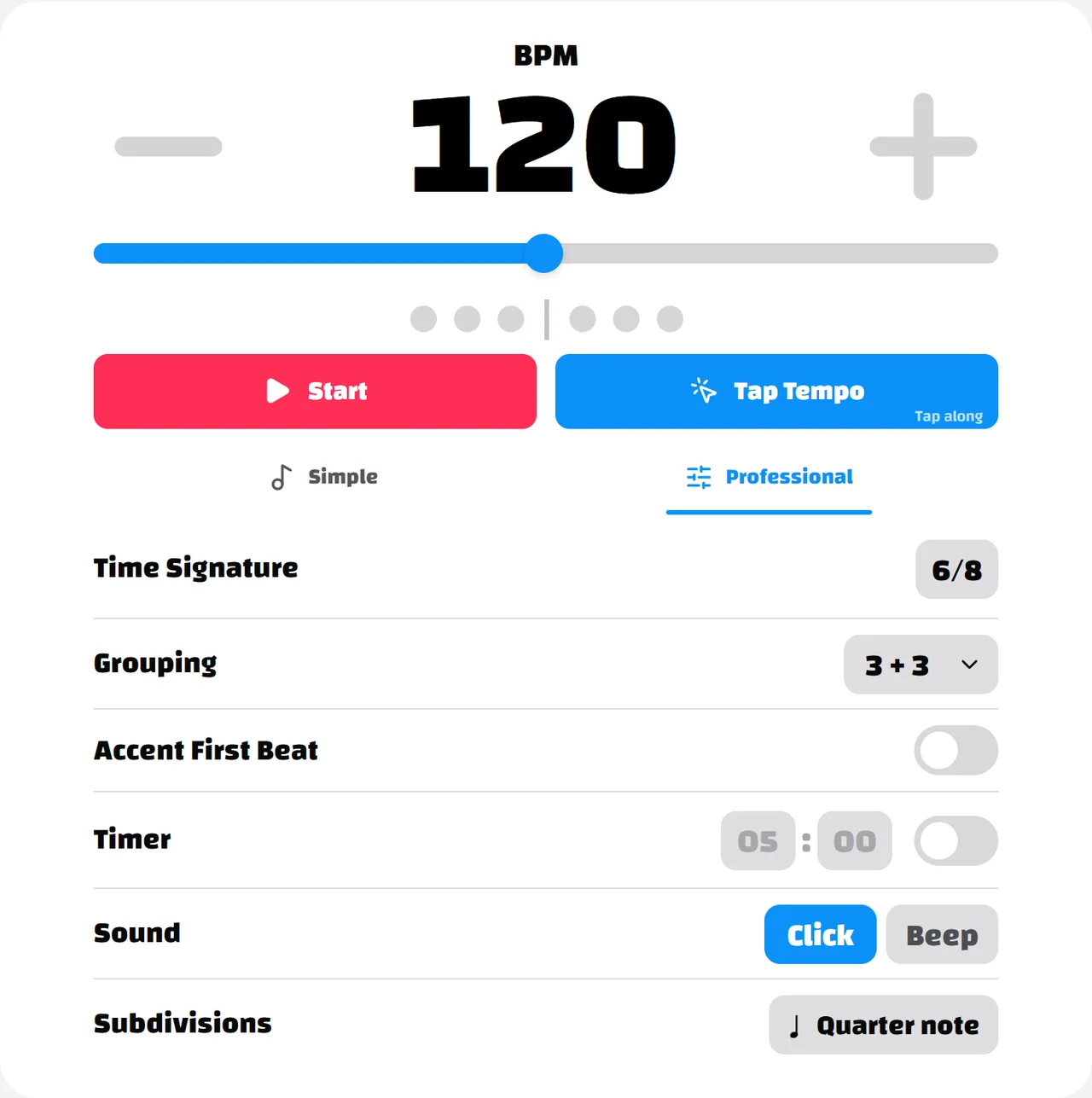
Read note units, then find the pulse
The lower number names the written note value: 4 means quarter notes, 8 means eighth notes and 16 means sixteenth notes. The upper number tells you how many of those units fill a measure. This does not always equal the number of larger beats you feel.
In simple meters, beats usually divide into two equal parts. In compound meters such as 6/8, 9/8 and 12/8, three eighth notes commonly form a dotted-quarter beat. The following table separates written units from those larger pulses.
| Signature | Written units per bar | Common pulse or grouping |
|---|---|---|
| 2/4 | Two quarter notes | Two quarter-note beats |
| 3/4 | Three quarter notes | Three quarter-note beats |
| 4/4 | Four quarter notes | Four quarter-note beats |
| 6/8 | Six eighth notes | Two dotted-quarter beats: 3 + 3 |
| 9/8 | Nine eighth notes | Three dotted-quarter beats: 3 + 3 + 3 |
| 12/8 | Twelve eighth notes | Four dotted-quarter beats: 3 + 3 + 3 + 3 |
| 5/8 | Five eighth notes | Often 2 + 3 or 3 + 2 |
| 7/8 | Seven eighth notes | Often 2 + 2 + 3, 2 + 3 + 2 or 3 + 2 + 2 |
Compare 3/4 with 6/8
Both can contain six eighth notes, but their grouping differs. In 3/4, those eighth notes normally belong to three quarter-note beats: 1-and, 2-and, 3-and. In 6/8 they commonly form two groups of three: 1-la-li, 2-la-li.
Try 3/4 with a two-note subdivision, then 6/8 with the plain click and 3 + 3 grouping. To keep the eighth-note speed equal, set the 6/8 click BPM to twice the 3/4 quarter-note BPM. The bar duration then stays the same, while the stronger pulse positions change.
Translate a score's tempo marking
The BPM number needs a note value. This tool uses one click per written unit: a quarter note in /4, an eighth note in /8 and a sixteenth note in /16. Grouping changes the accents, not the time between clicks.
For 6/8 marked dotted quarter = 60, select 180 BPM: each three eighth-note clicks last one second. If the same score instead marks eighth note = 60, select 60 BPM. Do not multiply every 6/8 marking automatically; first check the printed note symbol.
| Score marking | Tool setting | Larger pulse |
|---|---|---|
| 4/4: quarter note = 120 | 4/4 at 120 BPM | 120 quarter-note beats per minute |
| 6/8: dotted quarter = 60 | 6/8 at 180 BPM, 3 + 3 | 60 dotted-quarter beats per minute |
| 6/8: eighth note = 60 | 6/8 at 60 BPM, 3 + 3 | 20 dotted-quarter beats per minute |
Hear a grouping before playing it
Choose Professional mode, select the time signature, then choose a preset grouping. Turn on Accent First Beat. The first click of the bar is strongest; the first click of each later group gets a lighter accent.
For 7/8, compare 2 + 2 + 3 with 3 + 2 + 2 at the same BPM. Clap or count each group start. The clicks remain equally spaced and the bar has seven written units in both cases; only the group boundaries move.
Use the score, not only a default pattern
A preset grouping is a starting point, not a universal accent rule. Phrasing, syncopation and the score's beaming may suggest another interpretation. A 6/4 passage may be felt in two groups of three or in another arrangement; the time signature alone does not settle every accent.
Begin with the available pattern closest to the passage. Practise counting it, then disable the accent to test your own sense of the measure. Subdivisions add sounds inside a click interval and should not be confused with changing the bar's grouping.
Try a time signature
