What Is BPM? Fingerstyle Guitar Song Tempos
Understand BPM and find reference tempos for 24 guitar recordings and transcriptions, including Twilight, Sunflower, Angelina and Drifting, with sources and practice links.
Find a useful tempo for your next guitar piece. This guide explains BPM, collects reference speeds for familiar fingerstyle repertoire and shows how to turn a recording tempo into a manageable practice tempo.
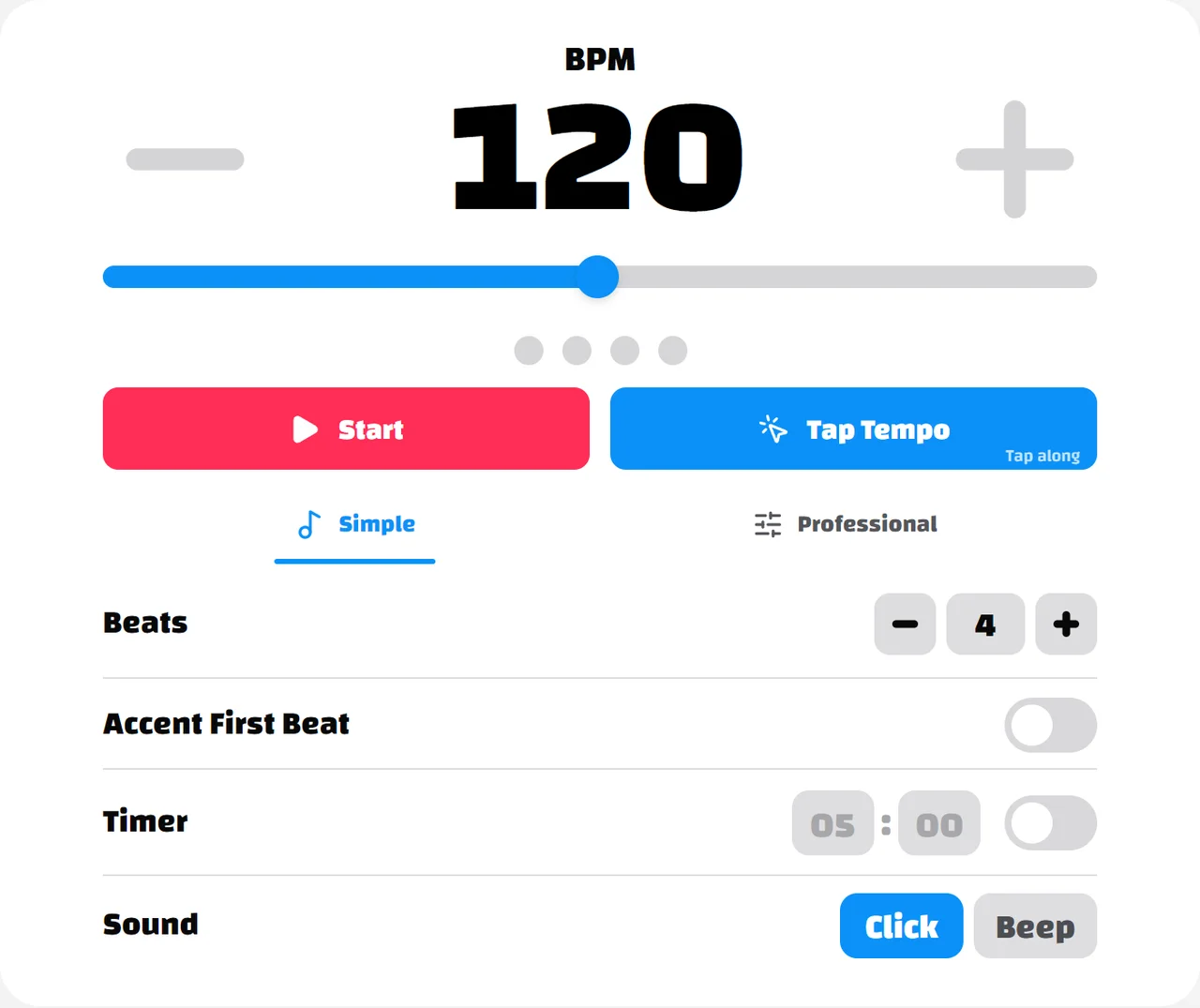
What does BPM mean in music?
BPM means beats per minute: the number of musical beats in one minute. At 60 BPM, beats are one second apart; at 120 BPM, they are half a second apart. A higher number means a faster beat. Yamaha's Playing With Tempo introduces tempo and its role in guitar playing.
BPM does not count every note you play. If a quarter-note beat is set to 80 BPM, four sixteenth notes can fit inside each beat without changing the tempo. Nor does BPM tell you how many beats belong in a measure: that is the job of the time signature. Check the note symbol beside the tempo marking on your score before setting the click.
Before choosing a song tempo
The tables below collect 24 source-listed reference tempos, checked on October 18, 2026. They are a repertoire reference, not a popularity ranking. These are not our own audio measurements: recording databases generally provide estimated tempos, while a transcription marking describes that particular score. Neither is automatically the composer's official instruction.
The version column matters. A live performance, a re-recording and a simplified arrangement may use different speeds. Durations identify database entries, not a promise that every recording of that length is identical. Approximate values are starting points for listening; expressive passages may not follow a fixed click.
Click a BPM to open that speed in the metronome. These links set the number only, not the piece's time signature, beat unit or subdivisions. Select those to match your score.
Japanese fingerstyle and Sunflower
Kotaro Oshio, Masaaki Kishibe and Paddy Sun offer very different rhythmic challenges. Use the relevant recording or transcription below rather than applying one number to every performance of the title.
| Piece | Performer and reference version | Reference BPM | Source and type |
|---|---|---|---|
| Twilight (黄昏) | Kotaro Oshio; 3:51 recording entry | 108 BPM | SongBPM estimate |
| Wind Song (風の詩) | Kotaro Oshio; 4:02 recording entry | 127 BPM | SongBPM estimate |
| Fight! | Kotaro Oshio; 3:21 recording entry | 124 BPM | SongBPM estimate |
| Landscape | Kotaro Oshio; 3:49 release entry | 118 BPM | Beatport listing |
| Big Blue Ocean | Kotaro Oshio; 3:35 recording entry | 106 BPM | SongBPM estimate |
| Red Shoes Dance | Kotaro Oshio; 3:19 recording entry | 135 BPM | SongBPM estimate |
| Canon (カノン) | Kotaro Oshio arrangement; 4:03 recording entry | 135 BPM | SongBPM estimate |
| Merry Christmas Mr. Lawrence | Kotaro Oshio arrangement; Starting Point, 5:50 | About 94 BPM | Trackify estimate: 93.6 |
| Hana (花) | Masaaki Kishibe; Hana single, 2020, 3:16 | 77 BPM | SongData estimate |
| Miracle Mountain (奇跡の山) | Masaaki Kishibe; SlowBE's third-party transcription | 75 BPM | Jitashe score listing: quarter note = 75 |
| Sunflower | Paddy Sun; Tùng A.G.'s 2012 third-party transcription | 120 BPM | Transcription marking: quarter note = 120 |
The last two entries are transcription markings, not verified original-recording tempos. In particular, use the Sunflower value with that arrangement's quarter-note count; it does not establish one mandatory speed for all covers.
Tommy Emmanuel repertoire
These entries refer to specific releases or performances. Classical Gas below is the orchestral performance, not a universal tempo for Emmanuel's solo versions.
| Piece | Reference version | Reference BPM | Source and type |
|---|---|---|---|
| Angelina | Endless Road: 20th Anniversary Edition | 127 BPM | Shazam listing |
| Since We Met | The Journey Continues | 93 BPM | Shazam listing |
| Lewis & Clark | The Mystery | 100 BPM | SnapLyrics estimate |
| Mombasa | 2:46 recording entry | 138 BPM | SongBPM estimate |
| Classical Gas | With the Australian Philharmonic Orchestra, 1997 | 150 BPM | Chordify estimate |
Andy McKee repertoire
All five entries refer to Art of Motion as indexed by the linked databases. Their estimates are references for those tracks, not fixed score markings; check your count against the recording before practising.
| Piece | Reference version | Reference BPM | Source and type |
|---|---|---|---|
| Drifting | Art of Motion; about 3:11 | 127 BPM | SongBPM estimate |
| Rylynn | Art of Motion; 5:13 | 77 BPM | GetSongBPM estimate |
| For My Father | Art of Motion; 3:55 | 119 BPM | GetSongBPM estimate |
| Into the Ocean | Art of Motion; 3:52 | 82 BPM | GetSongBPM album entry |
| Art of Motion | Art of Motion; 3:25 | 125 BPM | GetSongBPM album entry |
Fingerpicked songs worth practising
These are song recordings, rather than instrumental solo arrangements. Their fingerpicked parts can be useful repertoire, but a solo guitar cover need not keep the source recording's tempo.
| Song | Performer and reference version | Reference BPM | Source and type |
|---|---|---|---|
| Blackbird | The Beatles; Remastered 2009, 2:18 | 94 BPM | SongBPM estimate |
| Dust in the Wind | Kansas; Point of Know Return (Expanded Edition) | 94 BPM | SnapLyrics estimate |
| Freight Train | Elizabeth Cotten; 3:12 recording entry | 91 BPM | SongBPM estimate |
More classics: choose an arrangement first
A familiar title is not enough to identify a practice tempo. The following pieces belong on a fingerstyle repertoire list, but this guide does not yet assign them a sourced, version-specific BPM. Use the marking on your own score or tap along with your chosen recording instead of treating a guessed number as fact.
| Piece | What to identify before setting the click |
|---|---|
| Drifting Clouds (流れ行く雲), Masaaki Kishibe | The recording or transcription, and its written beat unit |
| Nocturne, Masaaki Kishibe | The performer: Andy McKee also has a piece titled Nocturne |
| Spring Comes, Masaaki Kishibe | The particular score or performance you are learning |
| November, Masaaki Kishibe | The original performance or a named cover version |
| Guitar Boogie, Tommy Emmanuel's versions | The performance and any changes of tempo between sections |
| Romance / Spanish Romance | The edition, pulse and expressive timing |
| Greensleeves | The arrangement, time signature and beat unit |
| Castle in the Sky / Carrying You | The named guitar arrangement, not just the film theme title |
| River Flows in You | The guitar transcription rather than an unspecified piano performance |
Turn a reference BPM into a practice plan
- Choose a short passage and a tempo at which both bass and melody stay clean. The table is a reference speed, not a beginner's minimum.
- If the passage breaks down at 120 BPM, try a slower setting such as 60 BPM. This is a practice example, not a prescription to halve every song's tempo.
- Keep the same beat unit as you increase the setting. After several accurate repetitions, try a small increase, such as 2-5 BPM. Step back if timing or movement becomes uneven.
- Return to the recording and listen to phrasing, accents and space. A steady exercise does not mean the final performance must ignore expressive timing.
For this website's Professional mode, the click follows the written time-signature unit. In 6/8 it represents an eighth note: a score marking dotted quarter = 60 therefore needs 180 clicks per minute and 3 + 3 grouping. See the metronome practice guide before copying a score's number into a different beat unit.
Common questions about guitar BPM
What BPM should I use for Twilight?
The linked 3:51 Kotaro Oshio recording entry lists 108 BPM. Treat that as an estimate for that entry, not the only correct tempo for Twilight. If you are following another recording or a score, use that version's pulse and marking.
Is Sunflower 120 BPM?
The Tùng A.G. transcription linked above marks quarter note = 120. That supports a setting for that score, not a claim that every Paddy Sun recording or cover stays at exactly 120 BPM.
Why do BPM websites disagree?
They may index different versions, analyse a different section or identify a faster or slower pulse. Half-time and double-time readings are one possibility, not an explanation for every disagreement. Count through a steady passage and compare the click with the beat unit in your score.
What is a good BPM for a beginner?
There is no single beginner BPM. A slow melody and a dense fingerstyle pattern make different demands at the same setting. Start where you can keep the rhythm, avoid unnecessary tension and repeat the passage accurately.
Ready to practise? Open the metronome, find a recording's pulse with Tap Tempo, or check your guitar tuning before you begin.
